 español
 September 19, 2026

dejar un mensaje
Si está interesado en nuestros productos y desea conocer más detalles, deje un mensaje aquí, le responderemos lo antes posible.


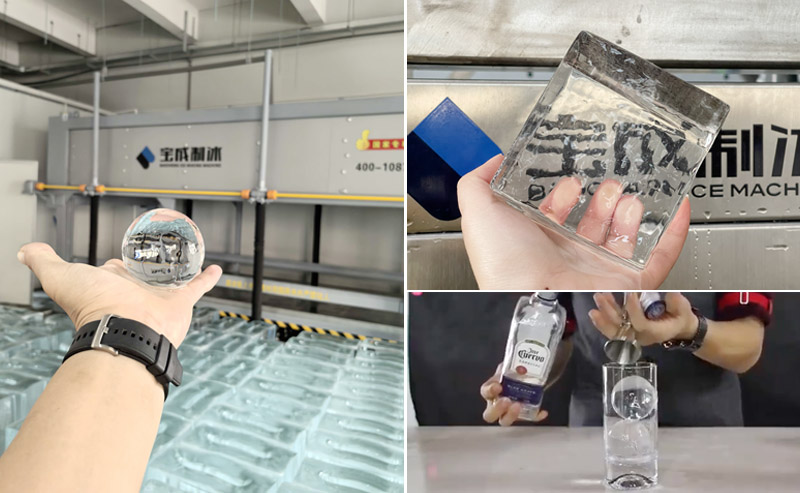
Clear ice is not only a visual product in bars and restaurants. Dense, transparent ice melts more slowly and evenly than cloudy ice, so it dilutes the drink less and keeps the intended serve temperature longer. Appearance and melting behavior both affect the bar's cost per serve.
The bar application is the most visible entry point for clear ice. Large clear ice blocks are cut into cubes, spheres, and Collins spears. The transparency is what the customer sees first, but the density behind that transparency is what the bar notices over the course of a shift.
Cloudy ice contains trapped air. The air pockets make the ice less dense, and less dense ice melts faster. Clear ice, produced through directional freezing and flowing water, is denser and melts more slowly.
The bar application connects the machine specification to the end product. A bar that cuts blocks into spheres needs blocks thick enough to yield a clean sphere. A bar that serves Collins spears needs the block oriented to the cut.
BAOCHARM has supplied 3-ton batch clear ice machines to bar operators in Indonesia, with the block configuration selected around the cutting plan rather than around machine capacity alone.
Figure 1: Clear ice block cutting plan for bar use — the block type and dimensions should be matched to the final piece.
Ice sculpture places the strictest transparency demand on the block, because carving exposes the interior. A white core or internal cracks become visible as soon as the block is shaped, and a block that cracks during carving cannot be recovered.
The sculpture application is where the acceptance standard matters most. A bar can work around a slightly cloudy corner by cutting it away. A sculptor cannot — the block is the material, and a defect that appears mid-carve wastes both the block and the carving time.
This is why the transparency standard for sculpture work is visual and strict: no white core, no bubbles, no cracks, evaluated through the block rather than at the surface. Directional freezing and flowing water are the process conditions that make that possible.
The block size also matters differently here. A sculptor may need a larger block for a specific piece, which is why custom mold sizes are common in this application. The freezing time changes with the block size, so the cycle should be confirmed for the specific dimensions.
The existing BAOCHARM article on culinary aesthetics and ice sculpture covers the aesthetic side of this application.
Clear ice is used in seafood display and short-term preservation where appearance and hygiene both matter. The absence of brine contact is the hygiene advantage of direct cooling; the transparency is the display advantage.
Seafood display is a different use from bar ice. The block is not cut into spheres; it is used to chill and present the product. The requirements are:
The block type for seafood display is usually solid, because the block is used whole or in large pieces rather than cut into small shapes. The 3-ton batch is the more common starting point for a single display operation; a distributor supplying multiple seafood counters would look at the 6-ton model.
Figure 2: Seafood display application — clear ice provides both the hygiene advantage of no brine contact and the visual advantage of transparency.
A distributor needs consistent batch output and a block that travels well, rather than a block optimized for a single cutting plan. The distributor's customer is the bar, hotel, or venue, and the distributor's product is the block itself.
The distributor application is where the batch capacity decision becomes most visible. A distributor supplying hotels, bars, and event venues needs to plan production against orders, not against a single end use. The questions are:
For distributor supply, the 6-ton model is often the relevant configuration because it provides a larger batch per cycle without extending the freezing time proportionally.
A 6-ton batch unit is in delivery to a distributor in Brazil, configured for resale to venues that specify clear ice.
The application logic is the same across the Middle East, Southeast Asia, and Latin America, but the mix of buyer types differs.
| Region | Primary buyer types | Application emphasis | Block type tendency |
| Middle East | Bars, restaurants, distributors, event venues | Bar service using clear ice, event cooling, display | Solid blocks for display and event use; center-hole where cycle frequency matters |
| Southeast Asia | Bars, restaurants, distributors, seafood trade | Bar service (Indonesia: 3-ton batch units), seafood display, distributor supply | Solid blocks for seafood and display; center-hole for bar cutting plans that allow it |
| Latin America | Bars, restaurants, distributors | Bar service using clear ice, distributor supply (Brazil: 6-ton batch unit in delivery) | Solid blocks for cutting yield; center-hole evaluated against the cutting plan |
The table reflects buyer types observed in BAOCHARM projects in these regions — including 3-ton bar units in Indonesia and a 6-ton distributor unit in Brazil — not a fixed market segmentation. The final selection still depends on the specific application and the cutting plan.
Q: Can one clear ice machine serve both bar and seafood display applications?
A: Yes. The machine produces clear blocks; the application determines how the block is cut or used.
Q: Do bars need a different block type than distributors?
A: Not necessarily, but the priorities differ. A bar cutting blocks into spheres needs a block thick enough for the final piece. A distributor reselling full blocks needs consistent batch output and transport durability.
Q: Is clear ice required for seafood display, or is standard block ice sufficient?
A: Standard block ice can chill seafood, but clear ice offers the hygiene advantage of no brine contact and the display advantage of transparency.
Q: How does the region affect the choice between 3-ton and 6-ton models?
A: The region affects the buyer mix, not the machine logic. A distributor supplying multiple venues may need the 6-ton model. A single bar or restaurant typically starts with the 3-ton model.
Q: Can the machine produce blocks for ice sculpture?
A: Yes. Ice sculpture requires a block that is clear through the full thickness, which is the same acceptance standard as other clear ice applications.
Q: Does clear ice for bars need to meet a different transparency standard than clear ice for display?
A: The acceptance standard is the same: no white core, no bubbles, no cracks.
Every application depends on the same four process conditions staying under control: freezing speed, water flow, water quality, and demolding stress. The maintenance and troubleshooting checklist is covered next.
Send us your application and cutting plan. BAOCHARM will reply with the block type and batch size that fit your end use.


Nuestros contactos
Correo electrónico: sales@baocharm.com
WhatsApp: +86 17663537579
WeChat: +86 17663537579
Horario de trabajo: lunes a sábado de 8:30 a. m. a 5:30 p. m.
 Red IPv6 compatible

