 español
 September 19, 2026

dejar un mensaje
Si está interesado en nuestros productos y desea conocer más detalles, deje un mensaje aquí, le responderemos lo antes posible.


Selecting an industrial flake ice machine starts with one decision: do you need the coolant to remove heat fast, or to hold cold for a long time? Flake ice is the fit for rapid heat removal — seafood pre-chilling, concrete batching, reactor temperature control. Once ice type is fixed, size the machine against your warmest expected site conditions, not the nameplate rating, then verify wetted material, compressor duty and condenser type against your water source and installation format.
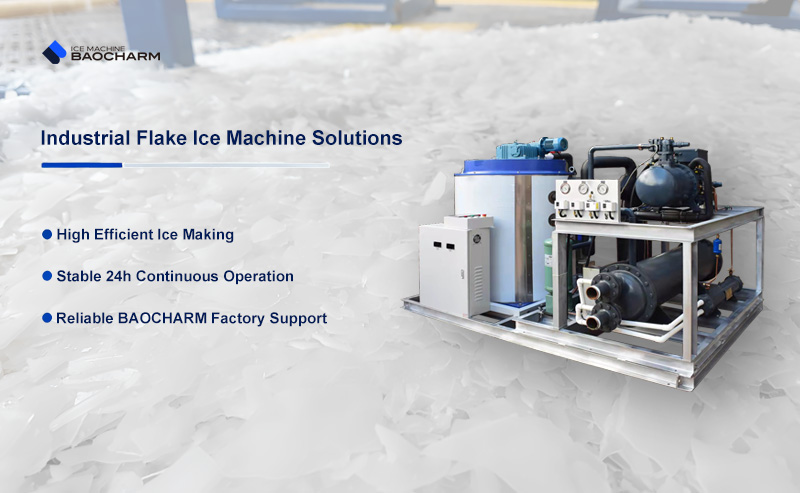
Most industrial ice enquiries begin with a number: 3 tons, 5 tons, 20 tons. Capacity becomes meaningful only after the ice type is fixed, because flake ice and block ice serve different cooling logics.
Flake ice is thin, dry and sub-cooled, with a very high surface area per ton. It wraps around product, enters gaps between items, and melts quickly — releasing latent cooling where the heat is. Block ice is dense, with a low surface-area-to-volume ratio. It melts slowly, which is why it is specified for cooling duration rather than rapid heat exchange.
The working rule: if the process needs temperature to drop within minutes to hours, flake ice is the candidate. If the need is a cold mass that holds over days in storage or transport, block ice is the candidate. The full comparison sits in the companion article Flake Ice Machine vs Block Ice Machine: Which Ice Type Fits Industrial Cooling and Preservation?.
| Cooling need | Recommended ice type | Typical applications Detail |
| Rapid pre-chilling; temperature drop within minutes to hours | Flake ice | Seafood landing, meat processing, concrete batching, reactor cooling |
| Long-duration cold retention in storage or transit | Block ice | Distant-water holding, cold-chain storage without re-icing |
| Both rapid cooling and long holding | Flake ice for pre-chill + block ice for holding | Seafood processing with storage buffer |
Ice type is a process decision, not a product preference. Confirm against actual holding times and handling constraints.
Rated capacity is established under defined test conditions. AHRI ice harvest rate, for example, uses 32°C ambient air and 21°C inlet water as typical rating conditions; laboratory ratings may use 21°C ambient and 10°C inlet water. BAOCHARM ratings commonly reference conditions in the range of 32°C ambient and 20°C inlet water.
Your site is the variable. If a machine rated at 5 tons/day under moderate conditions operates at 38°C ambient and 28°C inlet water, delivered output can fall materially below the nameplate figure. Industry sizing guidance commonly suggests adding 15–20% above the calculated requirement, and hot, poorly ventilated installations may require larger correction. In adverse back-of-house conditions, a 25–30% derating is sometimes applied before the peak-demand margin is added.
| Condition | Ambient (°C) | Inlet water (°C) | Estimated output vs rated |
| Laboratory rating | 21 | 10 | Baseline / near nameplate |
| Typical rating | 32 | 21 | Nameplate reference |
| Hot site, air-cooled | 38 | 28 | Lower than nameplate; confirm with site data |
| Hot site, water-cooled | 38 | 28 | Smaller correction than air-cooled; confirm with site data |
Typical estimation under stated conditions; confirm with site data. Actual correction depends on condenser type, ventilation and duty cycle.
The companion article How to Calculate Flake Ice Machine Daily Capacity: Standard Conditions, Summer Correction and Sizing Margin provides the step-by-step worksheet for peak-demand sizing and storage buffering.
These choices rarely appear in the capacity headline, but they determine service life.
Wetted parts. The evaporator drum, ice blades, water distribution tray and storage contact surfaces are continuously exposed to water and ice. SUS304 is the sensible baseline for food and general industrial duty. For seawater feed or marine installation, SUS316 on wetted parts is the appropriate upgrade because of its resistance to chloride-driven corrosion. Marine-series machines commonly use SUS316L for the evaporator interior and ice cutters.
Compressor and condenser. Continuous industrial duty calls for a compressor rated for sustained operation. Condenser choice follows site conditions: air-cooled units suit smaller capacities and well-ventilated sites; water-cooled or evaporative configurations are more common as capacity rises or where ambient temperatures stay high. Air-cooled systems are water-efficient and lower in upfront cost but can struggle in extreme heat; water-cooled systems offer more stable output in hot or poorly ventilated rooms but consume more water. BAOCHARM configures flake ice systems around mainstream compressor platforms including Bitzer, Refcomp and Hanbell, with condenser type matched to the installation.
Fixed or containerized. Containerized systems suit remote projects, temporary batching plants and overseas deployments. The selection question is whether ice demand is permanent or project-based.
| Water source | Wetted parts | Condenser options | Installation format |
| Freshwater | SUS304 (baseline) | Air-cooled / water-cooled / evaporative | Fixed or containerized |
| Seawater / marine | SUS316 / SUS316L on wetted parts | Water-cooled or seawater-cooled; marine-grade materials | Fixed or vessel-mounted |
| Corrosive process environment | SUS316 where specified | Matched to site heat rejection | Fixed, with enclosure options |
Evaporator drum and ice blade assembly can be customized to duty. Water analysis and site conditions should drive the final material selection.
The working principle behind this customization is explained in How a Flake Ice Machine Works: Vertical Inner-Scraping Evaporator and Ice Blade Explained.
Seafood and food processing. Flake ice is used for rapid pre-chilling because it conforms to product surfaces and penetrates between items. Sub-cooled dry flake ice avoids introducing excess water into the product environment. Product reference: Industrial Automatic Flake Ice Maker for Fishery Processing; 3-Ton Fresh Water Flake Ice Making Machine for Food Processing.
Concrete cooling. Flake ice at −8 to −5°C can lower mix temperature by 6–11°C, with typical addition rates of 30–70 kg per cubic meter of concrete. Melted ice must be counted as part of total mixing water, or the water-cement ratio shifts. The estimation method and pitfalls are covered in Concrete Cooling with Flake Ice: Mixing Ratio, Mass Concrete Temperature Control and Estimation. Product reference: Full Automatic Ice Plant System 30-Ton Flake Ice Making Machine for Concrete Cooling.
Chemical and pharmaceutical processing. In exothermic reactions — nitration, diazotization, coupling, crystallization — the cooling medium must absorb heat as it is generated. Flake ice melts rapidly in the reaction mass; each kilogram absorbs approximately 334 kJ of latent heat, dropping solution temperature within seconds rather than minutes. Explosion-proof electricals and corrosion-resistant wetted materials should be specified explicitly at enquiry. The process logic is expanded in Why Use Flake Ice for Reactor Cooling? Chemical and Pharmaceutical Applications Explained.
Marine and fishing vessel duty. On-board machines face two additional constraints: seawater feed and vessel motion. SUS316 wetted parts address corrosion; structural design addresses motion. The configuration discussion belongs in Can a Seawater Flake Ice Machine Use Seawater Directly? Marine Configuration and 316 Stainless Steel. Product reference: Heavy-Duty 10-Ton Daily Production Ice Flake Maker Machine for Fishing Vessels.
| Application | Why flake ice | Key configuration focus | Product reference |
| Seafood pre-chilling | High surface area; wraps product; rapid heat removal | SUS304 / SUS316 wetted parts; hygienic water circuit | Fishery processing; 5-ton seafood preservation |
| Concrete batching | Melts completely; high latent heat per kg | Ice weighing and delivery; mixing-water adjustment | 30-ton concrete cooling system |
| Chemical / pharmaceutical | Near-instant latent heat release; controllable addition | SUS316 where corrosive; electrical classification | Food-grade / chemical-grade configuration on enquiry |
| Fishing vessel | On-board ice generation; no land ice logistics | SUS316; motion-resistant water system | 10-ton marine flake ice machine |
| Cold-storage integration | Buffer between production and draw-off | Insulated storage sized to demand curve | 20-ton cold-storage solution |
A flake ice machine is rarely a stand-alone unit in an industrial setting. Ice must be stored without bridging, conveyed to the point of use, and metered with reasonable accuracy. Insulated storage is commonly sized to hold roughly one-third to one-half of daily production to buffer between production and demand peaks. Screw conveyors, rake systems and weighing hoppers are part of the selection scope when ice feeds a batching plant or continuous processing line.
A machine that can produce the daily tonnage but cannot deliver it at the moment the process draws will underperform in practice. Storage and delivery belong in the flake ice system design, not as later accessories. Product reference: Large-Scale 20-Ton Daily Capacity Ice Machine with Cold Storage Solution.
BAOCHARM manufactures industrial flake ice systems in the 1–30 ton/day range as standard, with 30–50 ton/day configurations available on a project basis. Freshwater and seawater feed, air-cooled and water-cooled condensers, fixed and containerized formats, and SUS304/SUS316 evaporator options are within the configurable scope. Compressor platforms include Bitzer, Refcomp and Hanbell, matched to the duty profile.
The company has delivered flake ice equipment to markets including Kazakhstan and Uzbekistan in Central Asia, and Peru and Brazil in the Americas. Customer operating data is not published without consent; the selection sequence in this guide is built around engineering principles and configuration choices.
If your project falls outside the standard range or involves unusual water chemistry, duty cycle or site constraints, a configuration review against actual conditions is more useful than a catalogue selection.
What capacity should I choose for an industrial flake ice machine?
Start from peak daily demand under your warmest expected ambient and inlet water conditions, then add a sizing margin. A machine rated under moderate conditions may deliver materially less at high ambient and warm inlet water, so sizing from the nameplate figure alone risks shortfall. The companion capacity article provides a step-by-step worksheet.
Does ambient temperature really change flake ice output that much?
Yes. Higher ambient temperature increases the condenser’s heat-rejection burden, and warmer inlet water requires more heat removal before freezing begins. Air-cooled systems in hot, poorly ventilated rooms are most sensitive. Industry guidance commonly uses 15–20% as a starting margin, with larger corrections in adverse conditions.
What information should I send for a selection review?
Daily ice requirement and peak hourly draw, intended use, water source and typical inlet temperature, maximum ambient temperature, power supply, and installation format (fixed or containerized). With these, the configuration can be narrowed to a realistic shortlist rather than a generic capacity match.
Start with your site conditions. Send your daily capacity, water source, maximum ambient temperature and ice use, and our engineers will map the configuration logic for your project — not a single catalogue number. → Start a selection review


Nuestros contactos
Correo electrónico: sales@baocharm.com
WhatsApp: +86 17663537579
WeChat: +86 17663537579
Horario de trabajo: lunes a sábado de 8:30 a. m. a 5:30 p. m.
 Red IPv6 compatible

